15 March 2020
Extending Empathy is key to surviving COVID-19
‘Business Continuity’ makes room for ‘Community Health’ at our Agency, as we stare at an uncertain future in India and around the world.
I realised yesterday night that it took me almost 72 hours for the truth to sink in. The truth about COVID-19. In the interim I had processed gargantuan amounts of information shared by some of the leading epidemiologists, thought leaders and journalists from around the world, and I could barely start connecting the dots.
Fortunately I acted early, woken up from my stupor by conscientious colleagues who were ahead of me on the curve of awareness. A friend from Stanford Med School punched me in the face basis a scrappy plan I published on LinkedIn. “The question is what are you solving for first? Business Continuity OR Community Health?” he asked. “No — you CANNOT solve for both FIRST. Life is shades of grey. Decisions are black and white. In that lies the test of Leadership” he concluded.
Thursday (Mar 12) morning, I woke up worrying about my daughter studying in Florida, struck with the double whammy of a) an eviction notice from her college and b) announcement of Shut Indian Borders from Mar 13, rendering her effectively homeless. I patiently heard the frustrations of my spouse struggling to hack a distance learning solution from an ‘empty school’ in the hills. And I wondered, What am I going to do with my team of 100 odd people in Mumbai?
It was easy as long as I had my head dug into the sand that nothing is going to happen to us in India. It was more difficult to plan for the day the ‘shit hits the fan’ as Mr. Moore says it out loud in his podcast episode “The Awful Truth”. Even after you discount his conspiracy theory, it is bone-chilling to hear that the United states of America, the world’s most powerful country, now stands on a brink of a disaster. Click here to listen.
At the leadership meeting of our agency Experience Commerce, I bullied my young and rather inexperienced team (in such matters) to accept a charter that I had pre-decided in my head, even before I walked in to the meeting. Basically I was NOT ready to listen, even though I called for everyone’s opinion. Here is how the scrappy charter looked.
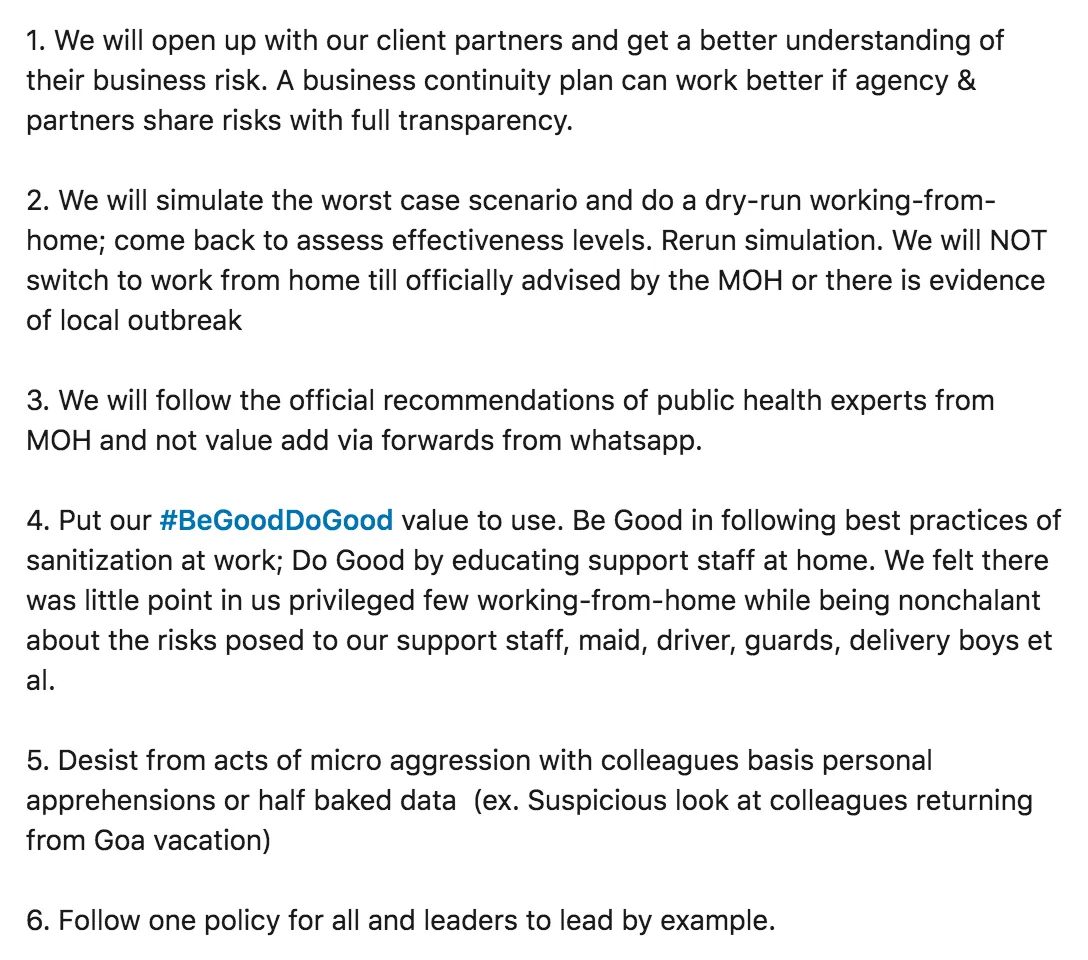
I was so worried sick about how we would absorb the shock waves of business (that was bound to ripple through), that I was not ready to listen and dig deep into understanding the criticality of “flattening the curve”, and how community initiatives of “social distancing” could help achieve the same. “Very Bad Idea” said my friend to Points 1, 2 & 3, explaining why a lag of even a few days between infection & evidence, evidence & advisory and subsequent action is LETHAL. “Err on the side of safety, at a community level. For those of us in leadership roles, we have an added responsibility here”, he implored.
24 hours later, armed with knowledge from decks and documents shared by my friend from Stanford Med School, I trembled at the magnitude of the shit that was likely to hit India, if we didn't ALL rise up to the occasion.
So here is what I did, aided by my team, subsequently over the past 48 hours, and suggest you do too.
Action Work-From-Home It was not as simple as asking people to stop coming to work on a Monday and open laptops at home. For a creative agency, used to huddling together to produce a piece of work, it meant quickly hacking a combination of tools and processes together. For a rather young team mostly in their early twenties, it meant dealing with COVID meme(s) first. This is what WFH 1.0 looked like over the weekend (Mar 14)
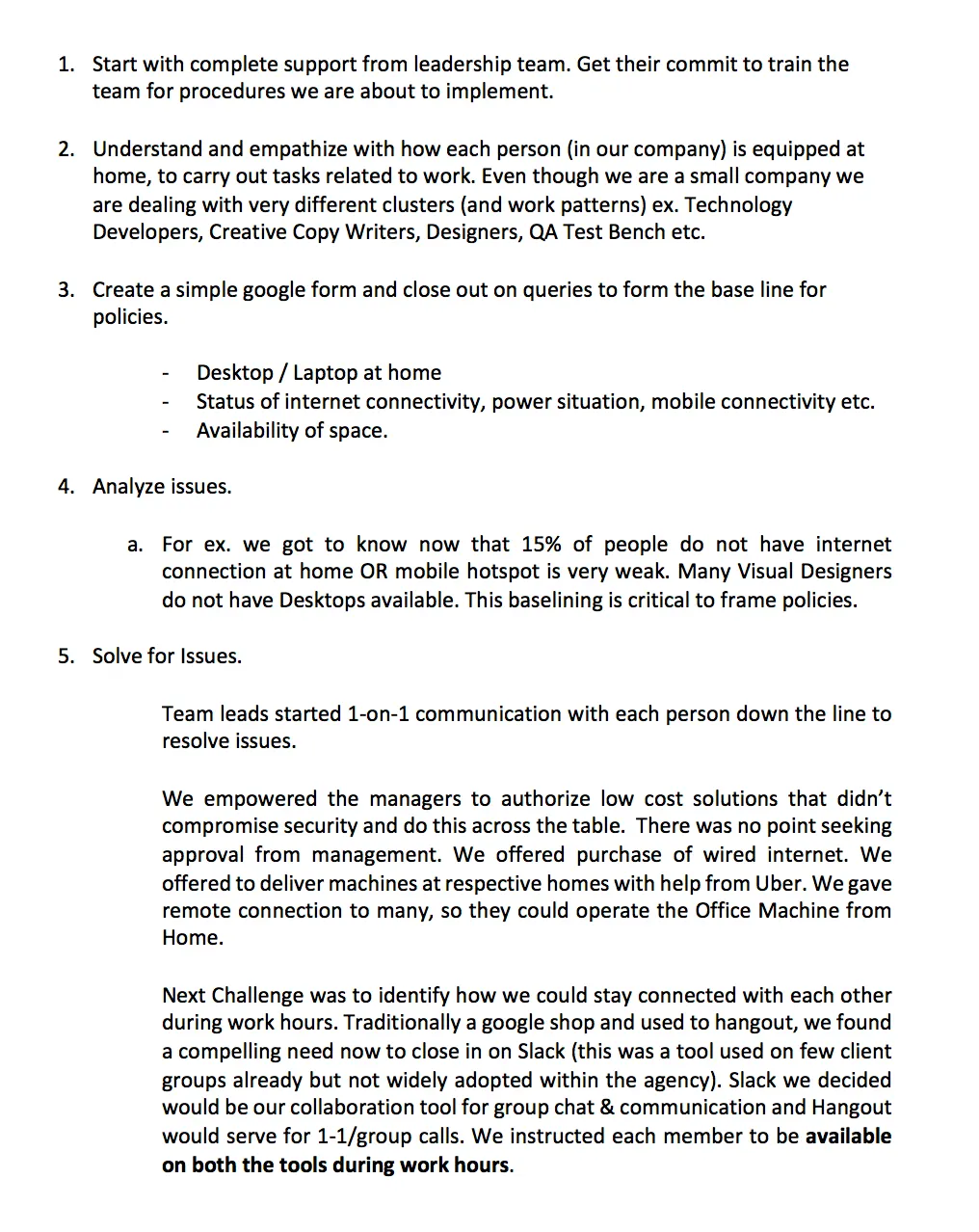
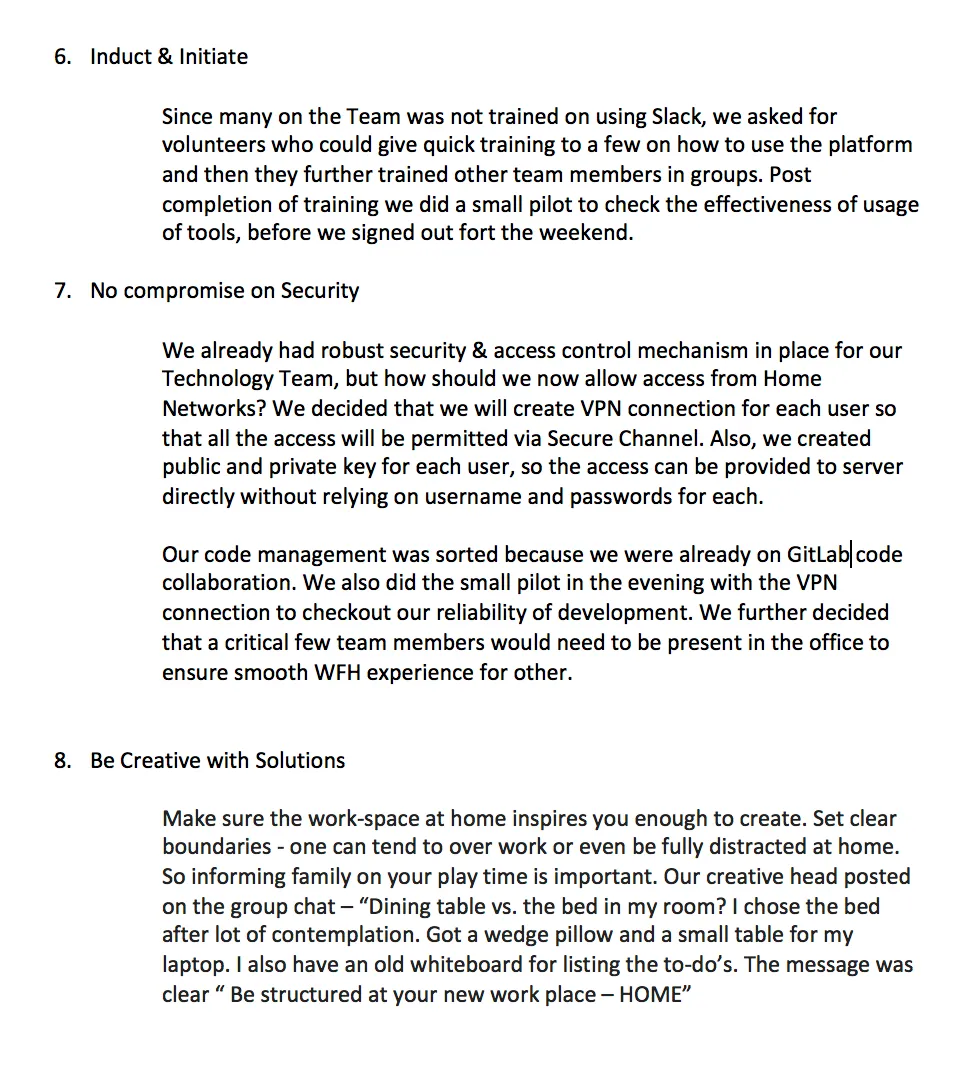
2. Communicate Internally and kickoff further discussion in the spirit of an AMA on the company WhatsApp channel. I was clear that we are on a path to learn together and there was no shame in acknowledging if I or others got stuff wrong the first time. Urge community education. WFH is not going to be effective if support staff at your home is still doing things the old way. Talk to your closest sphere of influence. Educate and Empower.
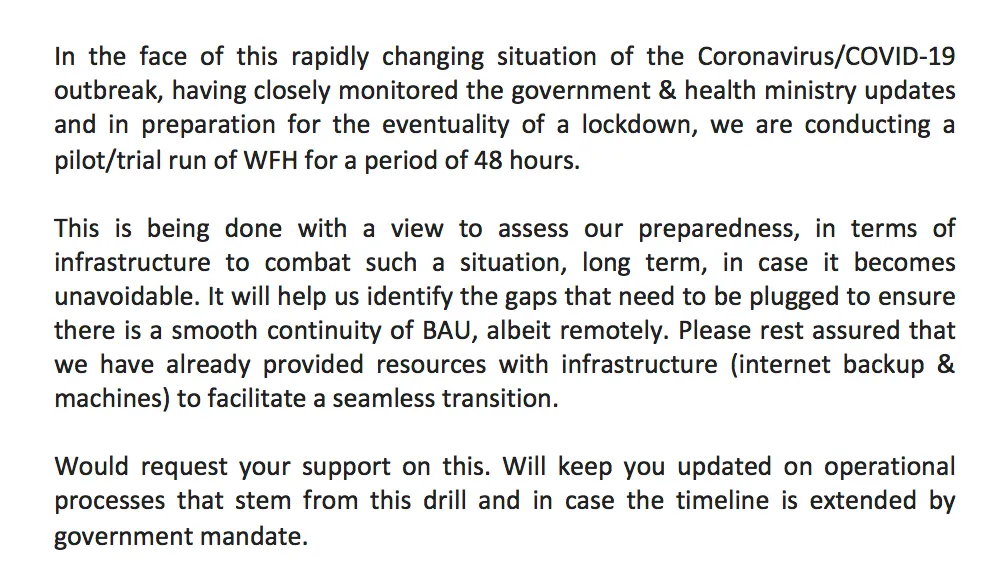
3. Reach out to clients to communicate your endeavour. I asked them for their support. Also offered our agencies help, pro-bono, if they needed additional support in communicating internally or to customers and partners. We are going to walk through this together, we felt.
4. Empathise, Empathise, Empathise & Be Responsible
There can be no better thing you can do at this point of time. If you are a powerful leader, think about your community first, then your business. Hold HQ at bay. Bureaucracy kills, and you should know it by now. Process all the data — Educate yourself to take the right call.
COVID-19 is not something that can be wished away. Barring a miracle, we are all going to walk into a stage 3 any-day now. It is not about mortality rates, likelihood of the summer heat overpowering the virus and neither it is the time to debate whether the government is doing the right thing.
This is about being socially responsible. Taking the tough decision is not about panicking BUT doing the right thing. If you are waiting for an incidence at your work place to pull the plug, it is the ultimate stupid thing you can do — endangering containing the virus, and sending it back home to houses with vulnerable senior citizens. So stop working on your next marketing campaign, and focus instead on meeting the needs of your employees and customer. Saw a text message from CROMA urging people to use their delivery service (now speeded up to 3 hours) to avoid the risk of coming in to the store. Simple but that showing signs of being a responsible business. Jammed with one of our client partner to explore what could be done to meet the needs of millions of kids suddenly trapped at home with no teachers to connect over virtually. What could be a solution? Next what? Champion a petition to the government to enter into a public private partnership and rapidly escalate ‘testing’ availability for suspected candidates. We are uniquely placed because of our maturity in home delivery of diagnostic services — could we not join hands to speed up testing?
Show some empathy. Think about whether the temp service people are getting paid due to the mall closure near home. Reach out, Find out. If you are the retail owner, DO NOT be like the jerks at Whole Food USA (owned by Bezos) asking people living pay-check to pay-check to donate their earned leaves to a pool for colleagues to tap into, if detected. Take time time out to educate your maid at home about why not to take the bus to work, starting NOW. Subsidise her travel. Reach out and offer services pro-bono — so many people will need help (not necessarily with money), if there is indeed,
.. a LOCK-DOWN.
First published on Medium on 15 March 2020.