17 June 2014
How to invest your digital marketing dollars?
Maximize Awareness or pay a Premium for Engagement? Invest in Assets or Expend on Content? Build Loyalty or Nurture Advocacy?

Deciding where to allocate your dollars is always a tough decision. This article presents an overview of the framework used in our agency that stacks multiple options in one unified perspective; helps build a rationale for the investments made towards achieving the key digital marketing objectives.
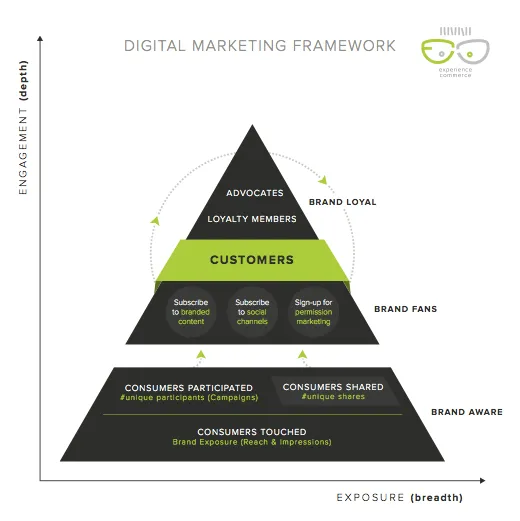
THREE easy steps to decoding the digital marketing framework and deciding where to park your dollars.
Step 1: Decide your target exposure & engagement metrics
Exposure to digital advertising (search & display) OR branded content is a direct function of investments in media. The depth of engagement with your audience online, (assuming that the advertising connects to a campaign that calls for participation), depends on the power of the creative idea and quality of content.
Interactive campaigns or share-worthy branded content need to be funded adequately to achieve a certain acceptable quality of production. Typically the ratio we recommend is 1:2 (i.e. for every one production dollar, allocate a minimum of two on digital media). To amplify the impact (awareness) of your campaign, use a minimum of 2 additional options of broadcast media.
The social plumbing of the interactive asset (website or app) and in general the power of the creative idea, will impact how many users chose to share (indicated in level 2 of the diagram above). The ability to orchestrate an interactive campaign to achieve wins in all the 3 metrics (awareness, engagement, virality) is related to the depth of past expertise of your agency.
Often campaign designers will sacrifice Engagement time (dimension Y) in favor of increasing breadth of Exposure(dimension X). In my opinion, it is a shortsighted approach that does not leverage a key property of an interactive medium; though one may argue that the ‘ability to target’ and thus narrowcast exposure is a good enough reason to use digital media.
Step 2: Acquiring Brand Fans from Campaigns
Once audiences get exposed to your brand via a creative campaign or content, they are quick to ‘like’ what they are presented with (happens anywhere within 1-3 minutes). It is usually an opportune moment, to get them to subscribe as a Brand Fan via whatever channel they landed.
If you are going to lead your future engagements with branded content, the consumers will usually give you permission to reach out, i.e. if he likes what he sees or reads. This permission could be granted on a brand asset that houses your content or campaign(s) or via a social channel.
How to nurture a fan and keep him engaged (post acquisition) is something that you will have to plan for early on; implicit in such plans are long-term investments for producing the experiences or branded content.
Step 3: The journey — a Brand Fan to a Paying Customer, and beyond.
The journey from being a brand fan to becoming a paying customer differs basis the product or service category. “Why Customers Really BUY” is an esoteric area of discussion, but what merits a separate post is how one can potentially nudge him/her in the right direction. For high involvement categories (like automobiles or gadgets or even health products), it makes sense to create niche and highly relevant communities. Advocacy plays a key role in decision support and especially when housed within niche communities, also builds aspiration. Communities certainly enable brands to stay connected with consumers over a longer purchase decision cycle.
For mass market brands that have low consumer involvement and are driven by impulse buys and first-trials, big numbers are key. Participatory branding, in such categories, is key to driving recall in retail purchase situations. POS and last-mile innovations are areas of investment worth considering.
All customers who are connected online via Branded Content, Services or Campaigns, leave behind their signature on a Brand’s digital and social assets, telling us what they like or dislike, what kind of communication they are most likely to respond to, their social behavior etc. When they explicitly give permission to market to them, they expect to be treated ‘smart’ (1-on-1) by Brands, and not as one large homogeneous mass of customers. They prefer narrow-casting of content, deals, opportunities.
To enable such programs, a Brand needs to invest in sophisticated data management programs that identify the consumer’s gene-pool (a fancy term to capture dynamic preferences). Such investments come in the later stages of a Brands Digital Marketing Maturity curve.
Takeaways:
Get the basics of exposure and engagement right. Chose the right metrics and invest accordingly. Pay a premium on engagement, if you believe in the theory of participatory branding.
Don’t use the term “brand fan” exclusively in the context of facebook fans. A fan by very definition is a consumer who liked what you (brand) shared with them, and explicitly declared his preference; could be on your digital asset, or even the YouTube channel. Its a big onus to keep a brand fan engaged.
Design for unification of brand experiences, as you deliver content and experiences on multiple different social channels. It is a big challenge and needs a deep dive into evaluating the digital behavior of the TG and the different cuts of branded content served up.
First published on Medium on 17 June 2014.