


Paper
Internal Model Predictive Control (IMPC)
E. Coulibaly, S. Maiti and C. Brosilow · Automatica, Vol. 31, No. 10, pp. 1471–1482, 1995
Real controllers work within limits: a valve can only open so far, a heater can only give so much. A controller that ignores these limits can drive a process too hard and then overshoot. Model predictive control (MPC) avoids this by predicting the future, but it must solve a large optimisation problem at every sampling time.
Our paper proposed a simpler way. IMPC starts from internal model control (IMC), computed from the states of a process model, so it always knows which control was really applied. Before it applies a control move, it looks one step ahead: if this move, followed by a move at the opposite limit, would push the model output past its desired path, it reduces the move.
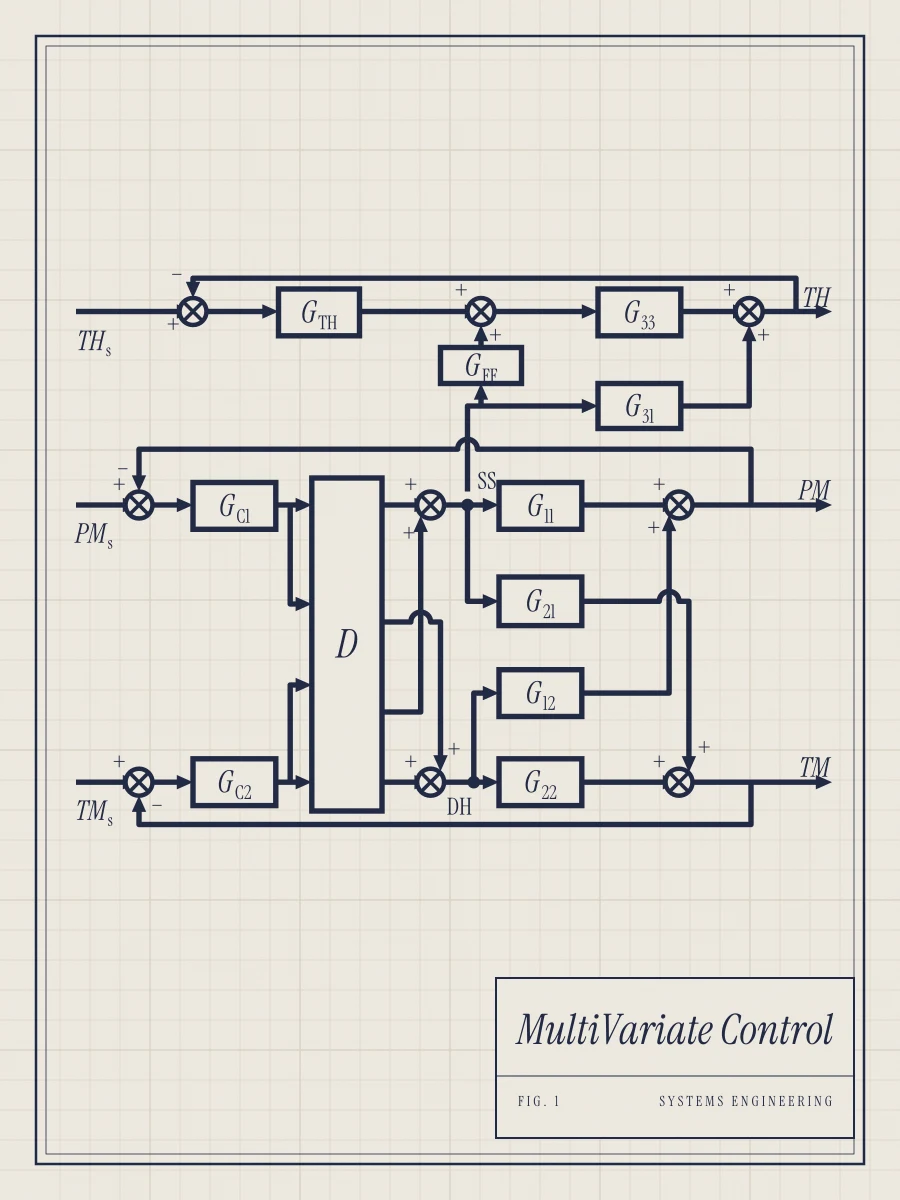
With no limits active, IMPC behaves exactly like IMC; when limits are active, it behaves like MPC. It has only one tuning parameter, the filter time constant. On single-variable test processes it matched or beat QDMC, a leading MPC method, for processes without right-half-plane zeros, with far less computation. A multivariable example from web control in film manufacturing showed how it handles saturation when many inputs and outputs interact.